Topics_ Grant Period 1 - 2025 |
| WG | Mode | Topic | Awardee |
|---|
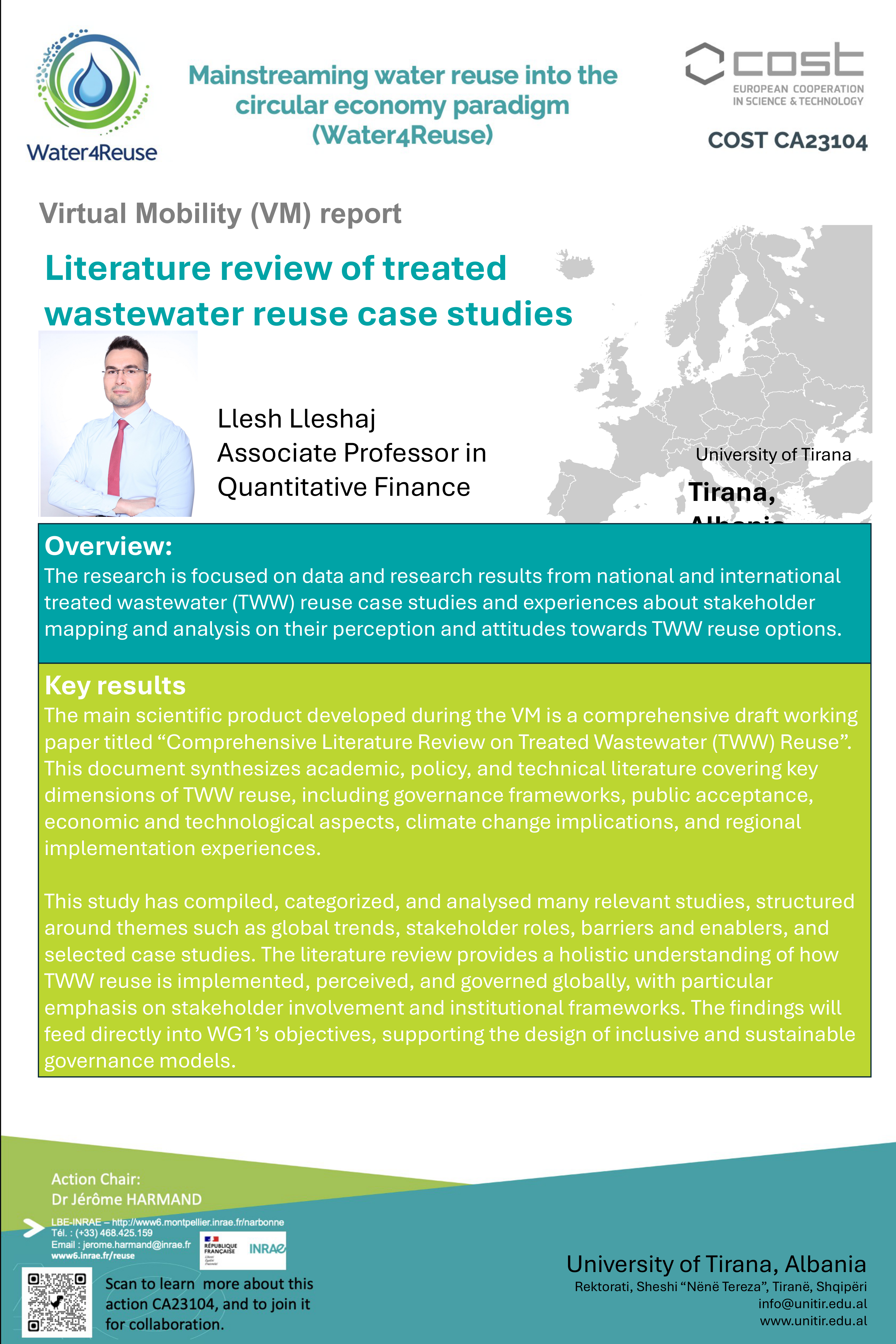
| 1 | VM | Literature review of treated wastewater reuse case studies | Llesh Lleshaj |
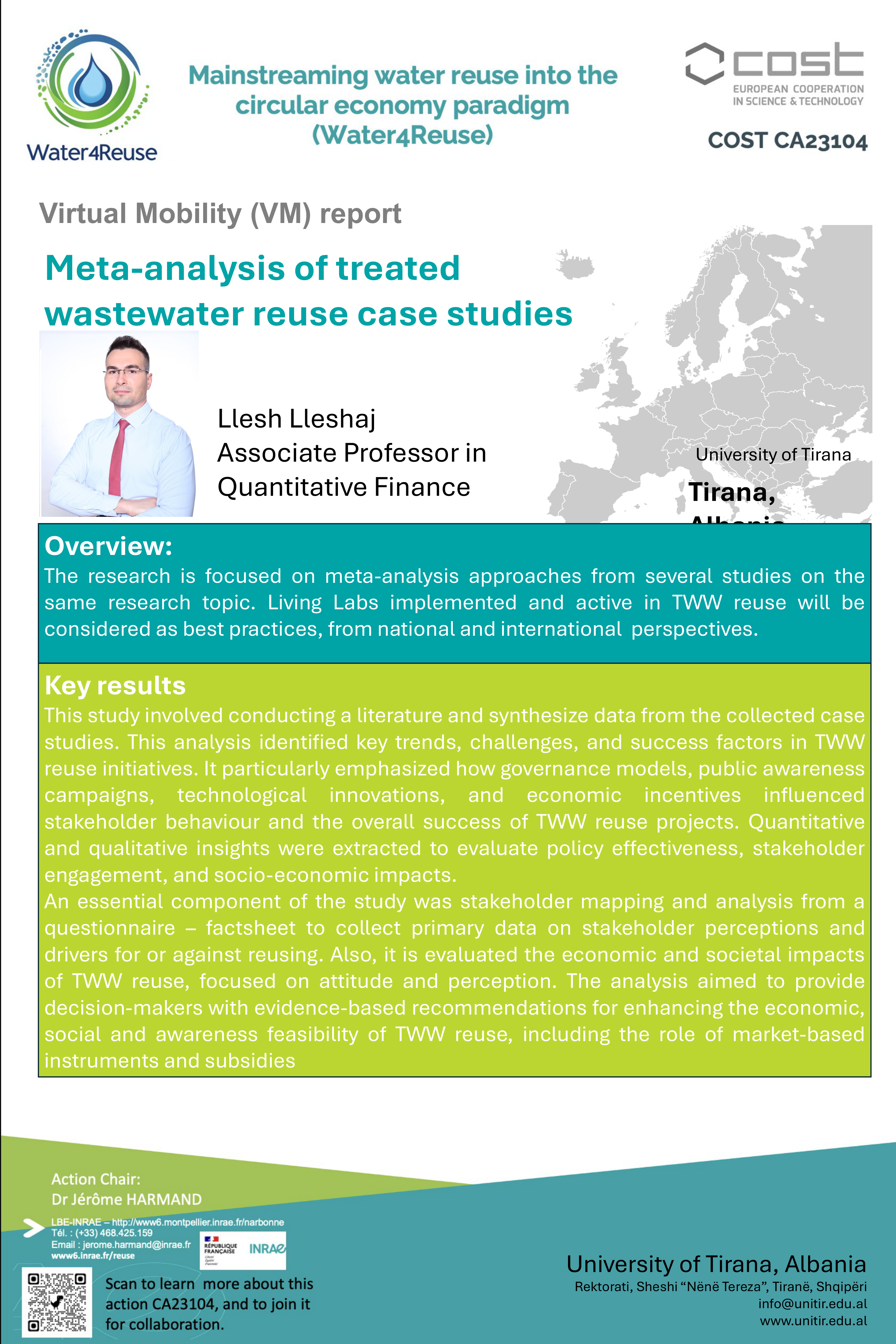
| 1 | VM | Meta-analysis of treated wastewater reuse case studies | Llesh Lleshaj |
| 2 | VM | Evaluation methodologies and approach for water remediation and reuse | Aday Amirbekov |
| 2 | VM | Evaluation methodologies and approach for water remediation and reuse | Zarko Vranjanac |
| 2 | VM | Evaluation methodologies and approach for water remediation and reuse | Çağlanur Sürmeli |
| 2 | VM | Remote sensing in the evolution of water pollution detection and monitoring | Hasan Burak Özmen |
| 2 | VM | Evaluation of best available technologies for implementing the multi-barrier approach | Aday Amirbekov |
| 2 | VM | Evaluation of best available technologies for implementing the multi-barrier approach | Edlira Pajenga |
| 2 | STSM | Innovative nature-based system for the removal of microplastics from water | Duygu Yanardağ Kola |
| 2 | STSM | Modelling and control pilot and full-scale treatment plants for the integration of technologies to achieve challenging water reuse standard | Filip Živković |
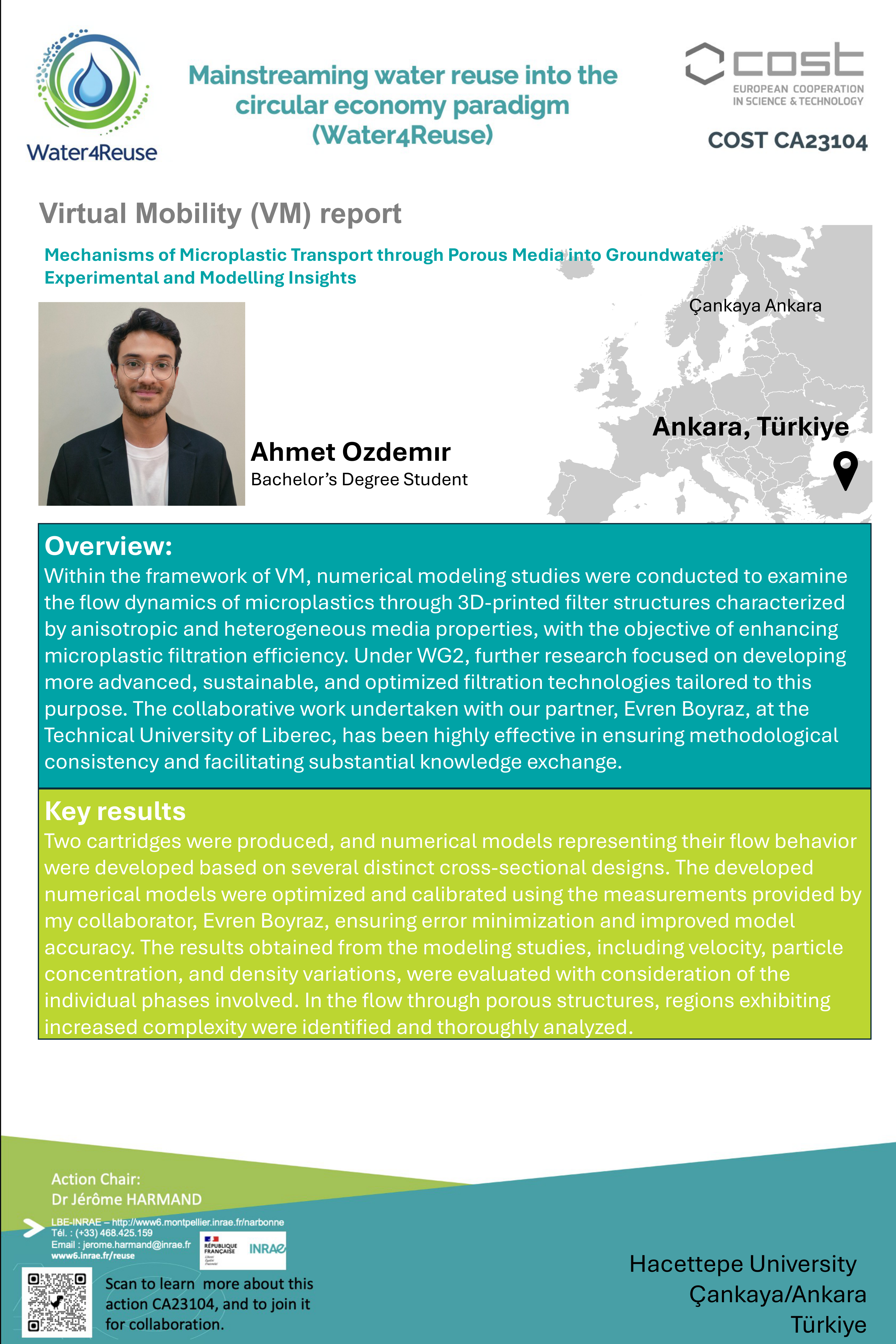
| 2 | VM | Mechanisms of microplastic transport through porous media into groundwater: experimental and modelling insights | Ahmet Özdemir |
| 2 | VM | Mechanisms of microplastic transport through porous media into groundwater: experimental and modelling insights | Oguz Kaan Ozay |
| 2 | VM | Integrated modelling and experimental analysis of porous media for microplastic filtration | Evren Boyraz |
| 3 | STSM | Validating a microbubble-enhanced cold plasma reactor for safe and decentralized water reuse | Jose Carita Goncalves |
| 4 | STSM | Modelling and control strategies for energy-efficient hybrid MBBR-NF systems in the treatment of saline wastewater for water REUSE in agriculture | Ahlem Kilani |
| 4 | VM | Comparative assessment of hybrid MBBR–membrane processes for saline wastewater treatment and agricultural reuse: methods, models, and risk indicators | Ferchichi Aroussia |
| 5 | VM | Metadata governance | Ibrahim Ozturk |
| 5 | VM | Data quality tools | |
WG1. Literature review of treated wastewater reuse case studies (VM1):
Llesh Lleshaj (University of Tirana)
This study provides a systematic synthesis of global treated wastewater (TWW) reuse, with a focus on institutional governance, public perception, and the socio-economic drivers of successful implementation.
WG1. Meta-analysis of treated wastewater reuse case studies (VM2):
Llesh Lleshaj (University of Tirana)
By conducting a rigorous meta-analysis of international case studies, this project identifies critical success factors and trends to support policy-makers in implementing sustainable water reuse initiatives.
WG2. Evaluation Methodologies and Approaches for Water Remediation and Reuse (VM1):
Aday Amirbekov (Technical University of Liberec)
By evaluating existing methodologies and integrating tools like Multi-Criteria Decision Analysis and Life Cycle Assessment, this project establishes a comprehensive framework for assessing wastewater treatment and reuse options. The work analyzes technical, environmental, and regulatory dimensions to support balanced decision-making and promote safe, sustainable water reuse practices.
WG2. Evaluation Methodologies and Approach for Water Remediation and Reuse (VM):
Dr. Žarko Vranjanac (Innovation Center, University of Niš)
By integrating ISO 14031 environmental performance indicators and Multi-Criteria Decision Analysis (MCDA) into a unified assessment framework, this project establishes key performance indicators for benchmarking water reuse systems. The work ensures alignment with EU directives and sustainability goals to support methodological and regulatory coherence in municipal wastewater remediation.
WG2. Evaluation of Municipal Wastewater Remediation and Reuse Strategies (VM):
Çağlanur Sürmeli Yıldız (Kayseri, Türkiye)
By critically synthesizing up-to-date scientific and technical sources on water reuse technologies, this project maps commonly applied environmental assessment instruments to support circular-economy oriented water reuse chains. The work establishes a categorized literature matrix for decentralized and peri-urban wastewater treatment and develops an LCA-focused framework that links environmental impact categories across the entire reuse value chain.
WG2. Best Available Technologies for a Multi-Barrier Approach in Water Treatment&Reuse (VM):
Aday Amirbekov (Technical University of Liberec)
By reviewing the best available technologies for a multi-barrier approach combining physical, biological, and chemical safeguards, this project addresses the challenges of growing water scarcity. The work identifies advanced treatment trains for effectively removing pathogens and emerging contaminants to support risk-based, adaptive management of reclaimed water within the circular economy paradigm.
WG2. Evaluation of Best Available Technologies for Implementing the Multi-Barrier Approach (VM):
Edlira Pajenga (University of Elbasan, Albania)
By focusing on water treatment methods and adaptive water management, this project develops a comprehensive framework for evaluating water treatment technologies and refining the multi-barrier approach. The work identifies practical strategies across diverse contexts to address emerging contaminants and provide stakeholders with actionable guidelines for ensuring sustainable and safe water reuse practices.
WG2. Innovative nature-based system for the removal of microplastics from water (STSM):
Duygu Yanardag Kola (Konya Technical University)
This research focuses on the fabrication of eco-friendly membranes using chitosan and MOFs, specifically designed to improve the efficiency of removing microplastics and dyes during water treatment processes.
WG2. Modelling and Control Pilot and Full-Scale Treatment Plants for the Integration of Technologies to Achieve Challenging Water Reuse Standard (STSM):
Filip Živković (Faculty of Technology and Metallurgy, Belgrade)
By evaluating contaminants of emerging concern and multi-barrier treatment strategies for safe agricultural reuse under EU Regulation 2020/741, this project addresses the integration, modelling, and control of advanced water reuse technologies. The work establishes baseline micropollutant removal through bench-scale UV-LED/H₂O₂ trials and validates a high-precision ion-chromatography method for volatile fatty acids to supply reproducible analytical protocols and actionable data.
WG2. Mechanisms of Microplastic Transport through Porous Media into Groundwater: Experimental and Modelling Insights (VM):
Ahmet Ozdemir (Ankara, Türkiye)
By conducting numerical modeling studies to examine the flow dynamics of microplastics through 3D-printed filter structures, this project aims to enhance microplastic filtration efficiency. The work focuses on developing advanced and optimized filtration technologies to ensure methodological consistency and support knowledge exchange through international collaboration.
WG2. Mechanisms of Microplastic Transport through Porous Media into Groundwater: Experimental and Modelling Insights (VM):
Oğuz Kaan Özay (Ankara, TR)
By establishing a clear workflow for designing and analyzing porous geometries and demonstrating the suitability of gyroid structures for uniform fluid flow, this project advances the understanding of microplastic transport. The work builds a foundation for future 3D modelling and extended simulations to enhance collaboration between hydrogeology and computational modelling fields while providing critical methodological input for future filtration and pollutant control studies.
WG2. Integrated Modelling and Experimental Analysis of Porous Media for Microplastic Filtration (VM):
Evren Boyraz (Technical University of Liberec)
By combining experimental testing of 3D-printed filter cartridges with advanced modelling and data analysis, this project investigates and optimizes microplastic removal mechanisms within anisotropic porous media. The work evaluates how pore geometry affects microplastic retention and establishes a foundation for next-stage cartridge optimization, including the integration of nanofiber layers and a transition to high-capacity 3D computational simulations.
WG3. Validating a Microbubble-Enhanced Cold Plasma Reactor for Safe and Decentralized Water Reuse (STSM):
José Gonçalves (NOVA School of Science and Technology, NOVA University Lisbon)
By evaluating cold plasma as an advanced water sanitation technology, this project demonstrates the potential of a microbubble-enhanced reactor for safe and decentralized water reuse. The work confirms the system's effectiveness against both gram-negative and gram-positive bacteria, achieves a 1–3 log reduction of antimicrobial-resistant (AMR) bacteria within 40–60 minutes of treatment, and supports the degradation of antimicrobial resistance genes to enhance environmental protection.
WG4. Modeling and Control Strategies for Energy-Efficient Hybrid MBBR-NF Systems in the Treatment of Saline Wastewater for Water Reuse in Agriculture (STSM):
Ahlem KILANI (University of Gabès, Tunisia)
By developing and simulating a hybrid system that couples biological degradation with membrane separation, this project addresses the critical need for sustainable saline wastewater treatment in agriculture. The work delivers an integrated MATLAB simulation framework that successfully combines a dynamic biological model with a mechanistic membrane model, enabling realistic predictions of overall system performance, permeate quality, and salt rejection under varying feed conditions to provide a foundational virtual tool for future optimization and advanced control strategies.
WG4. Comparative Assessment of Hybrid MBBR–Membrane Processes for Saline Wastewater Treatment and Agricultural Reuse: Methods, Models, and Risk Indicators (VM):
Ferchichi Aroussia (University of Carthage / CERTE, Tunisia)
By focusing on the modeling and optimization of hybrid MBBR–membrane systems, this project addresses the complex challenges of saline wastewater treatment for agricultural reuse. The work develops a coupled MBBR–membrane model that links biofilm kinetics with fouling behavior, establishes accurate parameter calibration under saline conditions, and designs energy-efficient control strategies to reduce aeration energy while maintaining stable effluent quality.
WG5. Metadata Governance (VM):
Ibrahim Ozturk (Osmaniye Korkut Ata University)
By developing a standardized MySQL database infrastructure for water reuse monitoring, this project addresses the organization and management of data related to reclaimed water reuse scenarios. The work initiates an interoperable data model and preliminary relational database structure to harmonize data definitions across working groups, establishing a conceptual foundation for a future EU-wide data infrastructure supporting robust metadata governance.
WG5. Data Quality and Modeling Tools (VM):
Dr. Dejan Vasovic (University of Niš)
This work investigates advanced data quality pipeline techniques and provides a curated shortlist of software tools optimized for the modeling and ecological evaluation of wastewater systems.